Kauaʻi record · kba_plant_taxodium_mucronatum
Montezuma Cypress
Taxodium mucronatum
Open this record in the interactive Atlas
About Montezuma Cypress
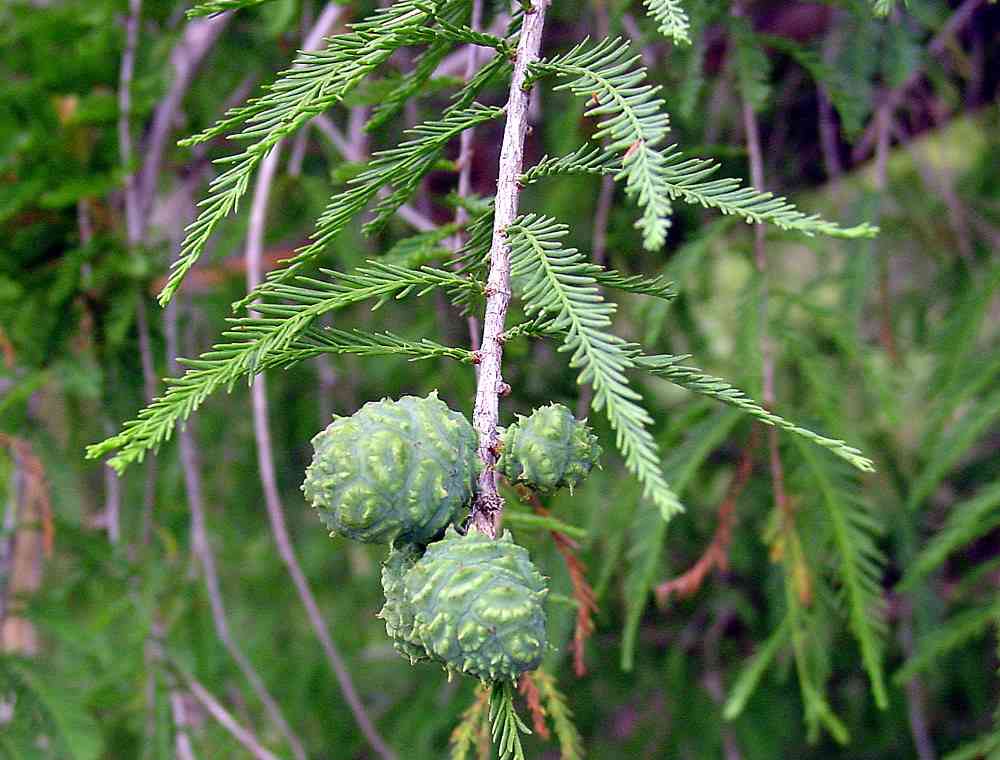
Montezuma Cypress (Taxodium mucronatum) is a post-contact introduced tree documented on Kauaʻi through historical forestry planting records. The reviewed records do not establish present survival. Native to southern Texas through Mexico to Guatemala, in subtropical river corridors and moist stream-bank soils. Seasonally drying stream courses support this taxon, and plants in such conditions apparently do not form knees. Government forestry records document historical planting on Kauaʻi under Taxodium mucronatum. Present survival, naturalization, abundance, reproduction and ecological effects are unconfirmed. Public occurrence is Kauaʻi island only.
Kauaʻi evidence
Taxonomic identity, tree form, diagnostic morphology and island occurrence use the linked reviewed sources. Historical planting, cultivation, naturalization and invasive status are separate. Generated imagery is not occurrence evidence. The 1918–1959 Kauaʻi reforestation working register records 912 plants under Taxodium mucronatum across 2 entries dated 1929. These are recorded planting quantities, not counts of surviving trees, and they do not by themselves establish current persistence, naturalization, or ecological impact. Source: Kauaʻi Reforestation Plantings 1918–1959 working register (user-supplied; reconciled 6 October 2026).
Names and classification
- Scientific name
- Taxodium mucronatum
- Common names
- Montezuma Cypress · Ahuehuete
- Other names
- Taxodium mucronatum · Montezuma cypress · Ahuehuete · Taxodium distichum var. mexicanum · Taxodium distichum var. mucronatum · Taxodium mexicanum
- Record type
- Species
Kauaʻi occurrence and status
- Kauaʻi occurrence
- Recorded on Kauaʻi
- Origin
- Introduced
- Conservation status
- Not yet assessed
- Evidence date
- 2026-10-06
- Evidence limits
- Current survival on Kauaʻi, numbers, occupied habitat, reproduction and ecological effects are unconfirmed; historical planting does not establish naturalization.
Habitat and ecology
- Habitats
- Not yet assessed
- Food and resource needs
- Not yet assessed
- Reproduction
- Monoecious conifer with pollen cones in long lax pendent panicles and woody seed cones that disintegrate when mature. Wingless strongly three-angled seeds are released from the scales; germination requires suitable moisture. Kauaʻi cone production, seed viability and recruitment are unknown.
- Shelter
- Not yet assessed
- Growth form
- Evergreen to semi-deciduous coniferous tree
Threats and conservation
- Monitoring
- Not yet assessed
- Data gaps
- Current population extent and trajectory · Additional species-specific ecological and conservation sources
Process and seasonal context
- Seasonal timing
- Not yet assessed
- Seasonal description
- Montezuma Cypress (Taxodium mucronatum) is a post-contact introduced tree documented on Kauaʻi through historical forestry planting records. The reviewed records do not establish present survival. Native to southern Texas through Mexico to Guatemala, in subtropical river corridors and moist stream-bank soils. Seasonally drying stream courses support this taxon, and plants in such conditions apparently do not form knees. Government forestry records document historical planting on Kauaʻi under Taxodium mucronatum. Present survival, naturalization, abundance, reproduction and ecological effects are unconfirmed. Public occurrence is Kauaʻi island only.
Sources and further reading
- https://powo.science.kew.org/taxon/urn:lsid:ipni.org:names:249723-2
- https://powo.science.kew.org/taxon/urn:lsid:ipni.org:names:60453296-2
- https://www.iplant.cn/foc/pdf/Taxodium.pdf
- https://research.fs.usda.gov/feis/species-reviews/taxmuc
- https://floranorthamerica.org/Taxodium
- https://www.desertmuseum.org/programs/alamos_trees_taxdis.php?print=y
- https://research.fs.usda.gov/download/treesearch/47617.pdf
- https://www.desertmuseum.org/programs/images/Taxdis02.jpg
- https://www.desertmuseum.org/programs/images/Taxdis03.jpg
- https://www.desertmuseum.org/programs/images/Taxdis04.jpg